Showing posts with label 2061ap3. Show all posts

Thursday, 9 June 2011

Research - Eve Arnold

Eve Arnold is a American photojournalist who was born in 1912.  She became interested in photography whilst working for a photo finishing plant in 1946.  She is very well known for photographing Marilyn Monroe but has also photographed Queen Elizabeth II, Malcolm x and Joan Crawford.  She joined Magnum Photos Agency in 1951 and became a full member in 1957.

Eve Arnold has travelled the world and much of her work has been in China, Russia, South Africa and Afghanistan.  In 1980 she held her first solo exhibition at Brooklyn museum in New York which showed her work done in China.  Also in 1980 she won a Lifetime Achievement Award from the American Society of Magazine Photographers. I particularly like her work of Marilyn Monroe.


This is a really great image of Marilyn Monroe.  She is the main focus in the picture and I like the way the background is blurred out. Colour is the main focus of this image and I really like the vibrant colours of the top and of the playground equipment.  This image has been shot at a really nice angle which is square on to the subject.  The composition aspect of Pattern is present with the top and the playground equipment giving lines, forms, shapes and tones.


I don't think that this image was a posed photograph which makes it a really good natural shot.  I like the contrast of the black and white top and I really love the old car.  The composition aspect of the rule of thirds is present with the subject and the trees in the background.  Pattern and texture is present throughout the image with shadows and reflections caused by the sunlight,


I like this image which I think has slight sepia tones. The composition aspect of lines with the window in the background and the image has used the rule of thirds with the position of the subject.  The black and white top is really nice and the tonal range is really nice with prominent high key tones.


This is my favorite Eve Arnold image as I love the way the light has been captured. This has been shot using a special type of film which has to go through eight processes to be developed.  This give this lovely milky colouring to the image.  There is a lot going on with this image and it clearly has a foreground, middle and background.  The main focus is the couple and the car.


I like the textures and patterns which are prominent within this image caused by the long grass.  The subject has been shot at the rule of thirds and the main focus is on the subject which has a nice contrast against the pattern and texture of the background.


This image has that lovely milky film which i really like.  I like this image as the subject is heavy in the frame.  I like the colours on the top and the brim of the hat is present completely in the frame.  This image has been taken at a low angle looking up at the subject which captures the brim of the hat really well.  Colour pattern and texture are present in this image and the main focus is the subjects face.
This main focus of this image is the subject and I like how the background has been blurred out by using a narrow depth of field.  This is a really simple image but very effective in its simplicity.  This image is predominately high key with very little low key tones.  The background is three tones of shade, pattern and texture. 

Tuesday, 22 March 2011

Research: Rankin

I have chosen Rankin to research as I am hoping I can learn more about expression and how to bring out the best in people to capture something really special, something more than just a photograph of a person.  I want to be able to capture the subjects personality and hopefully bring that out in the image captured.

John Rankin Waddell was born in Paisley Glasgow in 1966.  Rankin went to Brighton Polytechnic to study accountancy but by the age of 21 discovered that photography was his passion.  After doing a few college magazines in 1992 Rankin set up Dazed and Confused magazine with Jefferson Hack and by the mid 90s the magazine became really popular covering British Music,Art, Fashion and Film.

Rankin's style of Photography is Portraiture and particularly really intimate portraiture.  He is inspired by people and likes to know a lot about the people he photographs, to bring out the mood and emotion.  When photographing people he talks incessantly to the person to try and capture their personalities rather than just taking their picture.

After setting up the magazine this opened up opportunities to photograph Britain's pop bands including Pulp, Blur, Kylie and Madonna.  Rankin then propelled into doing covers for German Vogue, Harper's, Bazaar, Arena and GQ Magazine.

I like this image of Sienna Miller taken through a blind.  The composition is based around lines and reflection with a frame being made around the eyes.  This image has a good tonal range and the main focus is on the eyes which are framed between the blinds.  The image is in black and white and I love the way the shadow of the blind reflects over the face.  A shallow depth of field has allowed the background to blur out.


This image has the subject off set in the picture representing the rule of thirds.  I like this image the way the hair is blowing across the image and I also like the art work on the models skin with adds patten and texture especially within a black and white image.

I love the expression which has been captured in this image I almost imagine him to be roaring which just shows how Rankin likes to capture more than just a portrait but part of the subjects personality.  I like the way the subject is heavy in the frame leaning forward.  The expression shows great confidence with a little craziness which is probably what Rankin was hoping to achieve.

I like the position of this image which has been taken with the subjects head held back.  I like the way the image really shows the shape of the subjects face and a flawless complexion.  I really like this portrait, I like the colour used in the backdrop which contrasts really nice with the colour of the skin and the dark hair.


This black and white image has great patten and texture because of the tattoo.  He appears to be slightly off set which creates a slight rule of thirds.  The facial hair and the hair over the face has created a really nice contrast and tonal range.


This image of Pete Doherty is very low key with a good contrast caused by the black cat and the pale complexion of the subject.  I like the way they are both looking downcast with a doleful look.  I like this type of image with a dark backdrop and low key clothing with only the face lit by light.


This image shows the composition aspect of reflection and the Rule of Thirds.  I like the way that each side of the body has been captured in its own reflection the hand on one reflection and the gun on the other.  This image has good pattern caused by the shadow on the backdrop and the subjects legs causing an intertwined image.


I have seen many images of Madonna in the past but this shows her in a almost vulnerable pose which is not how we normally see her.  I think Rankin has captured something really special in this image by intertwining her hands almost like a child he has taken down the barriers of how we normally see her and left a rather humble expression.

Sunday, 20 March 2011

Research: Annie Leibovitz

Annie Leibovitz was born in Connecticut on 2nd October 1949.  Her father was in the US Air force and she took her first photographs while stationed with her family in the Philippines during the Vietnam War.  Annie attended the San Francisco Art Institute and developed her photography whilst working several jobs and living in Israel for several months.  Much of Annie Leibovitz inspiration was taken from the works of Robert Frank and Henri Cartier Bresson and their work of personal reportage.

In 1970 she began work at the Rolling Stone Magazine and in 1973 Jann Wenner co founder and publisher made her chief photographer.  During this time she photographed the Rolling Stones at the time Robert Frank was touring with them so she got to watch Frank work.  A few years later Annie got to go on tour with the Rolling Stones and be their tour photographer before going on to work for Vanity Fair and Vogue Magazines.


This is probably one of Annie Leibovitz most famous photographs of John Lennon and Yoko Ono taken on December 8th 1980.  Annie had wanted John on the front cover of Rolling Stone magazine but John wanted him and Yoko on the front cover.  It was Annie's idea that John should be naked and Yoko fully clothed.  This image shows his vulnerability towards his wife and how much he must have loved her.  John Lennon said she had captured their relationship perfectly.  A few hours after this picture was taken John Lennon was shot dead.


The next three of images are taken from Annie Leibovitz, American Music Exhibition which is a travelling exhibition of seventy black and white and colour images taken of American Musicians in intimate settings.
Twenty five years after starting at the Rolling Stone magazine Annie decided to photograph music with a mature eye so she travelled around America and created portraits with her own flair.  These images were mainly shot in 2001 and 2002 although she did use some images shot from the 70s.


This image is Pete Seegar an American Folk Singer and all that is captured is the banjo being held.  I really like images of musical instruments in black and white especially when captured  old musical instruments. The image has nice perspective and the composition aspect of the rule of thirds shot with a narrow depth of field the background is blurred bringing your focus to the instrument.  The image has a nice tonal range and contrast with the banjo against the background and the fret board.


This image of John Frusciante the former guitarist with the Red Hot Chilli Peppers has so much going on your eye is guided all around the image.  Using the composition aspect of the Rule of Thirds with almost everything within the image together with lines the subject seems unaware of what is happening almost lost in the music.  I think this image was taken after John left the Red Hot Chili Peppers and shows him alone surrounded by musical instruments and no band members. 


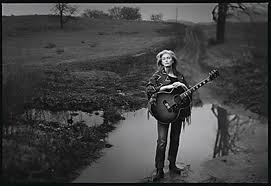
I really like this image of Emmylou Harris which was taken in Franklin Tennessee in 2001.  This image shows a country singer stood in the middle of the countryside with a guitar and this is the typical kind of work you can expect from Annie Leibovitz.   This image represents the composition aspect of lines and the rule of thirds as the road behind the subject guides the eye through the image.  This image appears to have been taken at an angle slightly above the subject which has ensured that the road and landscape behind has remained fully in the image.


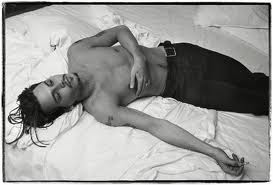
This image of Johnny Depp taken in 1994 in New York.  Johnny Depp has a really interesting look which makes him naturally photogenic.  This image shows Depp in dark trousers against his dark skin and dark hair which is then contrasted against a high key background.   His expression is listless and uninterested in whats going on around him.

Reportage is an important part of  Annie Leibovitz photography, the early images taken in the Philippines and later in 1982 she covered the Israeli invasion of southern Lebanon for the Rolling Stone.  This image was taken in Sarajevo in 1993.  Its almost as though the bike has come to a standstill and war has taken over.  Bikes can make very interesting images I think it must be the lines but this image I think is a sad image.


Celo, Bosnian Army Commander, Sarajevo 1993.  This image was taken during a trip in which Annie went to do a set of portraits which Vanity Fair agreed to publish.  You only had what you could carry, a backpack full of clothes, a bullet proof vest, a Contax with small variety of lenses and a Fuji 6x9 with fixed lens.


I like the contrast of this image with the low key background of the leaves and the high key tones of the chair and the dress.  The rule of thirds is present with the positioning of the subjects.  I like the textures which are created with the leaves and the fabric.


I really love this image which simply shows a contrast of expression.  A really nice contrast is present with the dark background and the image has a nice tonal range. The focal point is on the faces and the image is framed close to the subject.


This is one of my favorite images as I really like the colours within the image.  The colours have been achieved in post production which give a nice soft touch to the image.  The rule of thirds is present with the subject.  This image has been taken at a low angle which has captured the clouds in the background present prominent within the image.

Tuesday, 15 March 2011

Research - Black and White Photography

Since the beginning black and white images have been amongst the best to inspire and move us. Virtually all of us can appreciate that black and white images hold something very special and an average image shot in colour can almost come alive when converted into black and white. 

To see the world with monochrome vision is quite tricky but its good tip to switch your camera to monochrome and then use the LCD to view the world in black and white.  This way you can view different situations and view them in black and white without having to press the shutter.  It is however, better to shoot the images in colour and convert to black and white later in photoshop as this gives more control over the final image.

Using a Macbeth Chart also allows you to view the different colours in monochrome.


This macbeth chart is showing the colours when converted to black and white the charts vary slightly when different techniques are used such as desaturating and image and using the hue/saturation to convert images.

When shooting in black and white there is no colour to guide the eye around the image so you have to look for shapes, tones, patterns and textures.  Light and shadows also play a very important role as shadows create tone and contrast within the image.   Shapes and lines can also play an interesting role when producing good black and white images.


Filters and Monochrome

  • Red : Darkens the sky and foliage making this a good choice for moody landscape images.
  • Orange : This filter is similar to the red filter but with a less dramatic effect
  • Yellow : Less of an effect than orange.
  • Green : Darkens reds and blues and lightens greens and yellows.  This filter is good for portriature as it can improve skin tones.
Optical filters work better than the filters used in photoshop but as I do not have any optical filters as yet I will be using photoshop to use filters if needed.


Research Material Used

The Photographers Eye - Michael Freeman
Photographers Monthy - March Issue
Digital SLR Photography - March Issue

Saturday, 26 February 2011

Research: David Bailey

David Royston Bailey was born in Leytonstone, London and after leaving school at fifteen got a job as a copy boy at the Yorkshire Post in Fleet Street.  He was then called up for National Service where he served in the Royal Air Force and soon discovered the work of Henri Cartier Bresson which inspired him and increased his passion for photography.

David Baileys professional career started as a photographers assistant and he then went on to be a freelance photographer for Vogue Magazine in the late 1960s.  At this time London was in the swinging 60s which was the height of fashion culture for celebrities.  Along with Terence Donovan and Brian Duffy he was socialising with actors, musicians and royalty.  This is when Bailey revolutionised pop portrait which was previously formal and false.  In 1965 his Box of Pin Ups which is a box of thirty seven portrait poster prints done in half tone print include Terance Stamp, Jean Shrimpton, John Lennon, Paul McCartney, Mick Jagger and The Kray Twins. 
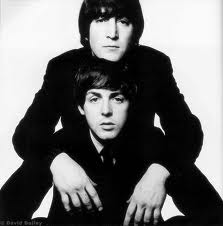
Of the thirty seven box prints thirty were taken against a plain white background a style much used today for portrait style photography. Bailey then used high contrast printing in some of  the images like this one of John Lennon and Paul McCartney taken in 1965 which developed the style even further.  I really like this image the high key background against the low key figure brings out a really interesting contrast.  The empty backdrop and the low key clothing demands you to look at the faces forcing you to study the expression.  They appear to be staring out endlessly at the viewer but I would say there mood seems relaxed, indifferent and unselfconscious.  The image has great shape against the background and the balance of both sides are almost symmetrical.

Music was a passion of Bailey's and he became great friends with Mick Jagger and the Rolling Stones in the early days and accompanied them in the early days when they were still playing tiny halls with minimal equipment.  Mick Jagger was also in Bailey's Box of Pin Ups with this image taken in 1964.
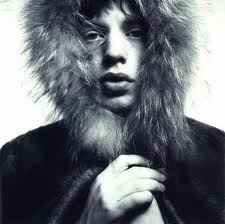

This is one of my favorite of Bailey's Box of Pin Up images.  A fresh faced Mick Jagger a young rock star in all his insolent androgynous glory.  This full frontal pose where just the head and the shoulders are heavy within the frame shows a stripped bare portrait of the young Mick Jagger with no artificial props or poses.  Again Bailey has used a plain white backdrop which shows good contrast against the texture of the fur hood around Jaggers head.  Bailey has used a direct flash for this image which has resulted in flawless luminous skin.  The bareness of the backdrop has been softened by the fur of the hood.   This image has a great tonal range bought together from the white backdrop and his flawless luminous skin together with the low key contrast of the fur around his shoulders which is then softened by the fur hood.  I really like the frame created around his eye with part of the fur from the hood.  There is great texture and patten within this image which is created by the fur hood which allows for a lovely shape against the white clinical cold background.
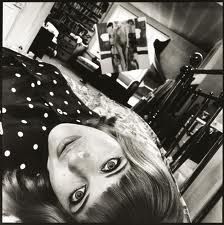

I really like this image shot of Pauline Boty in 1964.  The camera has been tilted which has created an unsettled composition.  The canvas picture in the background has been tilted in the opposite direction which creates further disorientation.  This aside I still really like this image that I feel has a lot going on.  The portrait is really close to the lens but the eye is guided into the image beyond the subject.  There is lots of patten and texture in this image and the composition aspects of lines forms a great part of the image together with angle.  I think this image has a really nice contrast with the spotted blouse and iron bedstead.  The main focus is the eyes but then you are very quickly guided around the image.
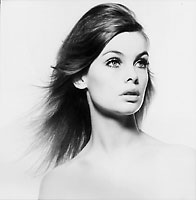

This image of Jean Shrimpton was taken in July 1965 and it was taken especially for the Box of Pin Ups.  Taken in the style Bailey seemed to adopt around that time against a white backdrop this portrait has a flawless look.  The high key tone and the great contrast of the hair demands that you focus on the subject.  The focal point is the eyes and you are drawn towards the facial expression.  Bailey shot this image with the camera just below her face which it seems you are looking up to her.  Bailey said she is narcissus in love with her own reflection.
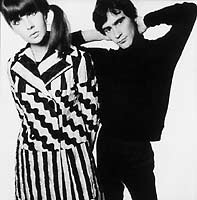
Bailey has shot quite a few images with black and white fashion garments much like this image of Chrissie Shrimpton and Ossie Clark taken in July 1965.  Using a white backdrop I like the choice of clothing Ossie dressed entirely in black and Chrissie wearing black and white makes the image high contrast with a really good tonal range throughout the image.  The image has nice patten and texture created by the black and white clothing and shows the composition aspects of lines, pattens and texture  The subjects are very heavy in the frame guiding the eye around the whole of the image but the focus still remains in the expression.
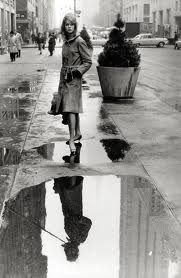
This is a fantastic image of Jean Shrimpton taken in 1962 in New York for British Vogue.  This was taken on Baileys first trip to New York when American photographers often came to London but British photographers were seldom invited to travel west.  This image represents the composition aspect of reflection and the way Bailey has captured the reflection in the puddle is great showing the composition aspect of the Rule of Thirds within the puddle.  I like the way the image in the puddle almost seems like a different image altogether almost like a statue.  The image has a really nice tonal range and appears like it has been shot high but at a tilted downwards angle.  I also like how the background shows street life and people just going about their day to day business.  I really like this image as I really like images with reflections within them two images in one which sometimes, like this, can look completely different.


In 2001 David Bailey was given a CBE and has been involved in numerous television commercials and documentaries and together with David Lichfield published the Ritz Newspaper.  He has photographed icons including Paul Weller, Jarvis Cocker and Razorlight.  David Bailey has also been a filmmaker, curator, environmental campaigner painter and sculptor as well as photographer.  Bailey has published many books to celebrate his work.

The genres of David Baileys photography go from fashion to portraiture, nudes to erotica and documentary to reportage.  Many of his photographs have been black and white, minimalist, graphic and high contrast between lighter values and darker tones.  Bailey has also produced some really powerful images of his wife Catherine Bailey giving birth to their daughter Paloma which must hold a personal feeling that only they can explain, he also has a books called Mrs. David Bailey by David Bailey and The lady is a Tramp.  In the collection The Lady is a Tramp these images are split into five different sections Nudes, Fashion, Pregnancy, Children and Beauty.  These images show Catherine Bailey in different incarnations as wife, mother, lover, seductress and Tramp.  Although I do admire much of Bailey's work it is the work photographing the music icons, high contrast shot in black and white and minimalist which inspire me the most.

Bailey has done various exhibitions including a major traveling show which opened at the Barbican, London in 1999 entitled "The Birth of Cool".  This exhibition includes an overview of Baileys life including works from "Box of Pin Ups" and "The lady is a Tramp".

Research Material Used

David Baileys Rock and Roll Heroes 1997
David Baileys Look Book - Jackie Higgins
David Baileys Locations - Martin Harrison
Internet

Monday, 14 February 2011

Experimenting with Monochrome Vision

I took a few shots over the weekend in black and white to experiment with the visual effect of monochrome, portraiture and instruments.  I also practised using the filters in photoshop to see what visual differences could be created.  These shots are taken with my Nikon D90 with 18-105 F3.5-5.6 lens and tripod which was needed for the very slow shutter speed

1/6s F5.6 ISO 400
This image was taken with very low light with a really slow shutter speed of 1/6s and a large aperture of F5.6 for exposure.  The ISO was set on 400 but I have since learned by researching black and white photography that the iso should be set on the lowest setting.  I have cropped this image so the face and the top curve of the guitar are quite heavy in the frame.  The image has a nice tonal range not high key or low key which probably keeps it from being a really interesting black and white image as black and white photography needs good contrast within an image.  I really like the hat, the patten and the texture have worked really well and I like the shape and pattern of the guitar. Also the creases in the clothes form a textured patten.  When working with black and white images you have to use pattens, shades and textures to create the image as you have no reliance on colour.

This image is the same as the previous image but I have used a yellow filter.  This has evened out the skin tone.  This visually has improved the image especially the face and has created some nice shading or shadowing throughout the image.  I think the contrast and the tonal range has been improved slightly by using the yellow filter although I have read that a green filter is good for evening out skin tone but the yellow worked better here.  I am not sure if filters can be used for the assignment I will need to check with Mr Steve.


This next image I have taken just as an idea of how equipment is going to look in black and white.  The guitar always looks great shot in black and white the strings and the frets adding great patten and texture. I have also noticed that dust collected along the guitar has added shading and tone to the image.  I have made a mental note not to clean any instruments between now and the shoot as even dust can create shading within a black and white image.

1/8s F5.6 ISO 400

Evaluation

I think that everything went well whilst concentrating only on people and equipment.  I need to go to the warehouse and see what shapes and texures can be used to create the desired contrast within my images.  It is however a large light open space so I think props and lighting are essential.  I will also shoot any future shots with the highest iso to see what difference it makes.  I am also going to practise looking with monochrome vision as good black and white photography requires tones, shades and textures and good contrast.  This experiment has helped me with assignment planning as I have been researching black and white photography.

Assignment 206 Statement of Intent - People and Portraits

Intentions/purpose of the photography to be undertaken

This is my statement of intent for my first theme People or Portraits.  I intend to create this theme around music and also produce the images in black and white.   I plan to use different instruments which could include the drums, guitar electric and acoustic, djembee drum and even possibly the mouth organ.  I am planning to shoot some of the images in the warehouse at work as there is lots of space and I hope the warehouse will add something to the images.  I will also shoot images at home and whilst out and about.  I intend to use my family and friends for the images.

Reasons for Selecting Theme

The reason for selecting this theme comes initially from the research I have been inspired by  Dennis Morris for his work with Bob Marley, The Sex Pistols and Marianne Faithful.  I have recently been researching Rankin looking at how he brings mood and emotion into portraiture and David Baileys work with John Lennon , Paul McCartney, Mick Jagger and The who to name a few.   This research together with my love of music and passion for black and white photography has inspired my ideas. 

Photo Imaging Equipment and media that will be used and why

I will be using my Nikon D90 Camera and 18-105 F3.5-5.6 lens.  I have just purchased a Nikon Nikkor Macro AF-S 105mm IF VR lens which is a macro lens which is supposed to be excellent for portraiture.  I will be using my tripod which will help with framing and exposure should a slow shutter speed be needed.  I am planning to buy some, acquire some or make some kind of studio lighting to help create the images.  I need to research studio lighting techniques as I have very little knowledge at the moment. I will use photoshop to crop and desaturate my images.  I have been using my phone as a remote control which will work when connected to my laptop via bluetooth but I will need to buy a remote for when I am away from home.  Using a remote means there is no camera shake as there is no need to press the shutter release.

Techniques used and how they will help convey the visual message

I will be shooting my images in black and white and then using photoshop to change to black and white as this gives more control over the output of the final image.  I need to check with Steve if filters can be used or only the original black and white image.  I need to start looking at things with monochrome vision as good black and white photographs need good contrast, tone and texture as something has to make up for the loss of colour guiding your eye around the image.

How light can be used to create the visual message

As my images will be in Black and White I plan to use light to create mood and also to create tone and contrast within the image.  A photograph with dark tones can create a moody, dark and somber image whilst light tones can be delicate and upbeat.  I would also like to use light to create shadows within the image of musical instruments and people. 

Evaluation

This will be a ongoing statement of intent which I will add to when more research and ideas materialise.  I hope I have not taken on too much, but I feel I need a challange as my last assignment theme was nature which was quite easy to acheive.